Modules / In actieve bouw
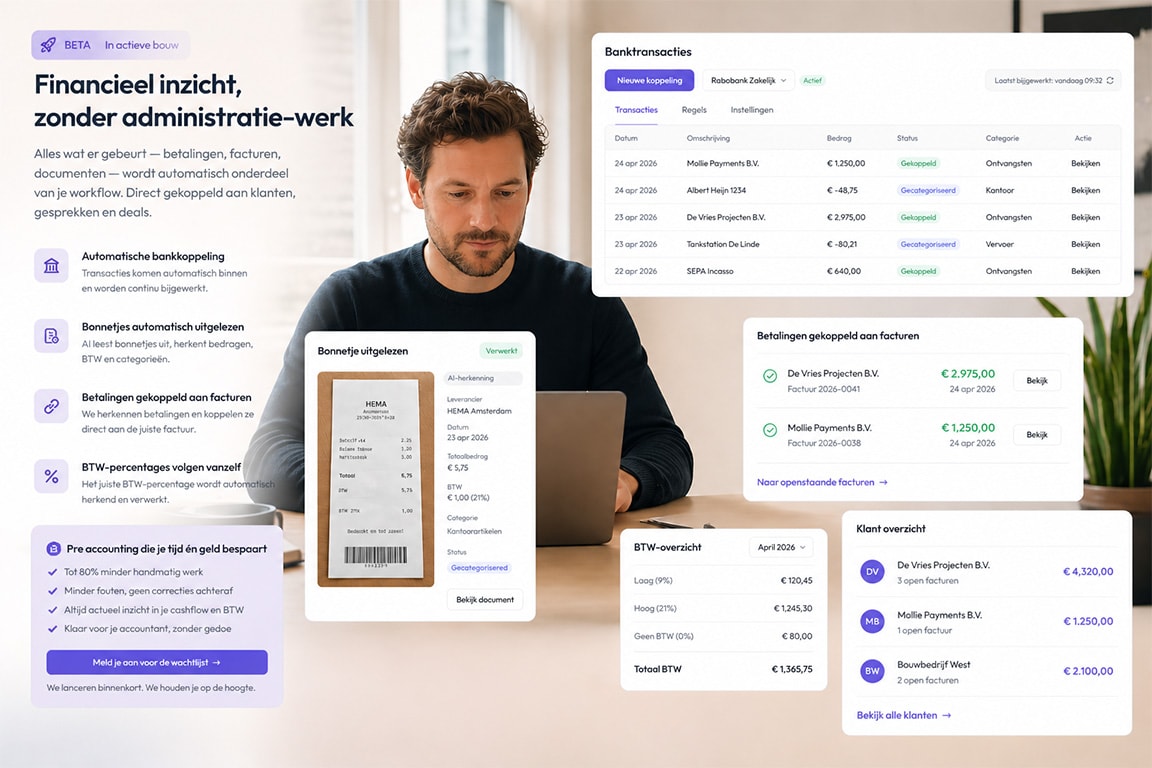
Bank transactions that belong to your invoices.
Bank transactions flow in automatically once the banking layer is enabled for your organization.
Receipts are read for you and connected to transactions where that makes sense.
Payments are recognized and matched to the right invoice, including partial payments.
VAT rates and accounting export belong in this flow, not in a separate tool beside bookkeeping.
What you get
01
From bank row to accounting-ready context.
Banking is where bank connectivity and billing meet. The banking domain manages provider connections and account identity; billing consumes transactions for enrichment, matching, payment state and export.
02
Bank connections
Enable Banking is the first provider layer for account access and identity
03
Transaction import
incoming and outgoing bank rows are ingested idempotently and deduplicated
04
Receipts and OCR
inbox and receipt data are paired with matching transactions
05
Invoice matching
payments are recognized against open invoices and payment states
06
VAT context
rates and amounts receive sanity checks for pre-accounting
07
Accounting export
transactions get supplier, description and category context
08
Accounting export
structured output toward accounting tools remains part of the flow
MODULE · BANKING AND ACCOUNTING
Banking en boekhouding brengen banktransacties, facturen, bonnetjes, creditnota's en boekhoudvoorbereiding dichter bij klant en werkcontext.
Why this is different
What separate tools create
Your banking app shows transactions, your invoicing system shows open receivables and your accounting tool asks for exports. Someone still has to connect amounts, receipts and payment states by hand.
How SideIQ draws the boundary
Banking owns provider connections, consent and account identity. Billing consumes transactions for matching, enrichment, VAT checks and export. That keeps the architecture clear without exposing users to disconnected systems.
Why it belongs here
A payment is not an isolated financial fact. It belongs to an invoice, customer, dossier and next action. Banking context should land in SideIQ where the work already lives.
Why this is necessary
Bookkeeping starts long before the tax return
Without connected banking and accounting preparation, your company has to keep figuring out which payment, invoice, receipt or credit note belongs to which customer or appointment. That preliminary work takes time, causes questions from the accountant and feels like a recurring administrative pain for many entrepreneurs.
That is exactly where individual financial tools fall short. They show transactions, invoices or exports, but don't always understand the customer context, document, appointment or workflow behind it. Once financial signals live outside SideIQ, the system loses context about what has been paid, what is missing and what still needs to be followed up.
SideIQ therefore makes banking and accounting preparation part of the Business Operating System. Bank transactions, invoices, receipts, credit notes, documents and customer context remain connected within the same workflow. The more financial signals pass through SideIQ, the better SideIQ Intelligence can help with matching, control, prioritization and preparation for your accountant. This makes accounting less searching and more controlled transfer.
Examples
Payment detection
an incoming payment updates the right invoice status
Receipt matching
OCR results and transactions are brought together
VAT checks
rates and amounts are checked before export
Reconciliation
bank rows, invoices and open receivables are reviewed from one context
Accounting export
finance receives structured data without manual bundles
Accounting export
the accountant receives structured data instead of separate bundles and questions