Adaptief / In actieve bouw
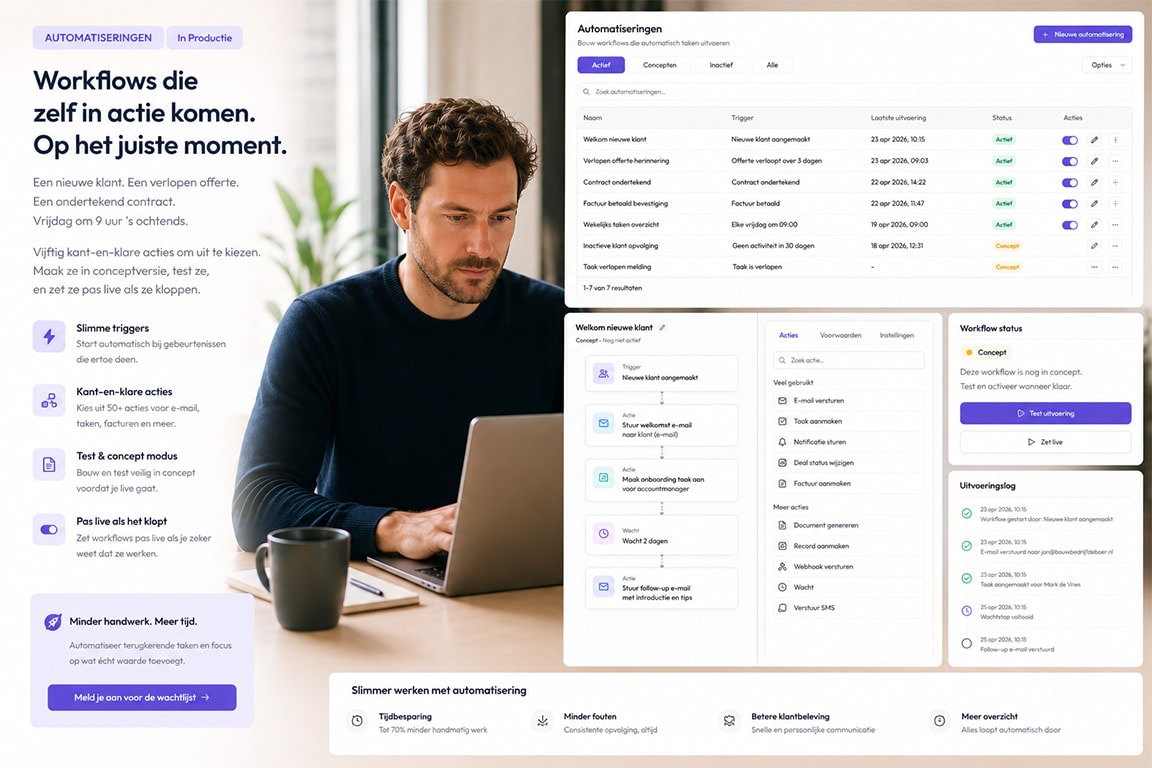
Workflows that move when it matters. Events, schedules, and signed-off runs.
Fire on platform events — new lead, expiring quote, signed contract, or a scheduled window you control.
Fifty-plus action types with draft/publish gates and run history for auditability.
Liquid-powered payloads, retries, and logging so failures stay visible.
Trigger families: record events, cron, webhook, and manual runs from the UI where policies allow.
What you get
01
50+ action types. Four trigger families.
Composable automations scoped to tenants with governance aligned to collections and modules.
02
Trigger modes
record lifecycle events, cron windows, inbound webhooks, manual starter buttons
03
Action catalog
email, billing hooks, collection updates, notifications
04
Liquid templating
interpolate record + context safely
05
Draft versus publish
rehearse transitions before activating production traffic
06
Run history
timestamped trail with outputs for support review
07
Retry-aware failures
operations log and reschedule instead of disappearing quietly
08
Context for SideIQ Intelligence
automations become visible as part of files, activities and corporate memory
ADAPTIVE · AUTOMATIONS
Automations voeren terugkerend werk uit vanuit echte bedrijfscontext: klanten, dossiers, collecties, documenten, planning, communicatie en statussen.
Why this is different
Silo-to-silo glue
Zap/Make style wiring strings siloed apps together yet every hop adds monitoring debt and brittle field mapping.
First-party orchestration
SideIQ executes inside the tenant boundary with CRM mail voice billing threads and AI context co-located.
Operational depth
Ship quotes, invoices, escalations, and tasks with full business context instead of spreadsheet columns.
Why this is necessary
Automation without context becomes vulnerable
Without connected automation, your business must build loose connections between tools that only partially understand each other. A trigger may know that a field has changed, but not always which customer, appointment, quotation, work order or next step belongs to it.
That is exactly where individual switching tools fall short. They move data, but often miss the full business context. This creates fragile workflows, duplicate rules and a lot of maintenance when processes change.
SideIQ therefore makes Automations part of the Business Operating System. Customers, files, collections, documents, planning, communication, invoices and AI signals can initiate actions within the same environment. The more work passes through SideIQ, the better SideIQ Intelligence understands when automation is useful and what action logically follows. This way you not only automate individual steps, but recurring work within the context of your company.
Examples
Quotation follow-up
once a quote has been sent, SideIQ can prepare a reminder, task or customer update
Invoice reminder
outstanding invoices can be automatically followed up with the right customer context
Work order completed
a completed work order can initiate reporting, billing, or customer communication
New lead
a form, email or telephone conversation can create a file, task and follow-up
Planning change
In case of changed agreements, those involved can be informed and actions can be updated