Adaptief / Productie
Adaptive how you operate. Connected everywhere work happens.
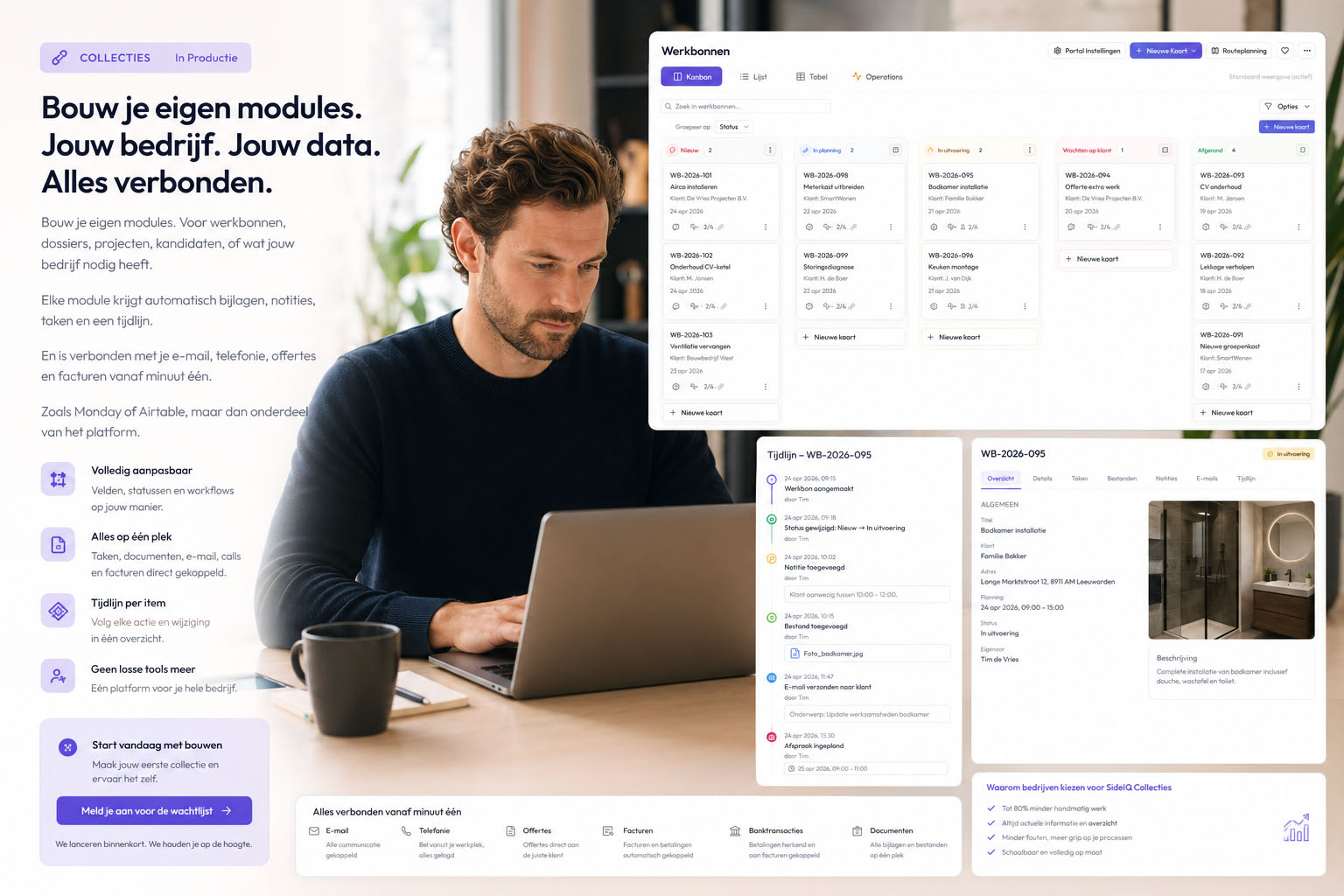
Encode work orders pipelines or bespoke dossiers beside your messaging spine.
Blueprint catalogue ships ready-made branches instead of week-long scaffolding.
Every record participates in quotations calendars telephony artefacts without duplicate IDs.
Threads keep conversations adjacent to transactional truth responsibly.
What you get
01
Familiar board ergonomics. But data stays inside governed SideIQ dossiers.
Collections model what makes SMBs distinct while blueprints install battle-tested scaffolding per vertical.
02
Field services
onsite photos signatures invoices close loops without juggling shadow apps
03
Recruitment
candidates vacancies matches living beside omnichannel conversation history
04
Real-estate dossiers
offers contracts documents inherit single thread narratives
05
Blueprint roster
real estate ticket recruitment project CRM presets immediately installable
06
Native linkage
opportunities mail voice artefacts share identifiers automatically
07
Threads
context adjacent to numeric records avoids mailbox archaeology
08
Context for SideIQ Intelligence
the AI not only understands customers, but also your own processes, objects and work structure
ADAPTIVE · COLLECTIONS & BLUEPRINTS
Modelleer werkbonnen, dossiers, kandidaten, assets of brancheprocessen als collecties die verbonden blijven met CRM, documenten, planning, facturen en SideIQ Intelligence.
Why this is different
Operational spine access
Tasks can trigger quotations invoices mail because they share tenancy with CRM artefacts — integrations optional not mandatory.
Thread coupling
Conversations escalate beside the same record lineage so audits stay linear.
SideIQ Intelligence
AI reads both relational fields and conversational signal — richer grounding as collections multiply.
Why this is necessary
Your unique work should not become a separate tool
Without adaptive collections, every company must choose between two bad options. Either you adapt your process to standard software, or you build separate spreadsheets, no-code boards and custom apps in addition to your core system.
That's exactly where a lot of business software falls short. Standard modules cover the basics, but as soon as you need your own objects, fields, statuses or industry processes, context disappears from the platform. Then the work order is somewhere different from the customer, the document is separate from the invoice and the AI misses the meaning of your unique process.
SideIQ therefore makes collections part of the Business Operating System. Your own data models, blueprints, files, activities, documents, planning and invoicing remain connected within the same operational layer. The more you model unique processes in SideIQ, the better SideIQ Intelligence understands how your business actually works. This way you get the flexibility of customization, without losing the coherence of your platform.
Examples
Pest control
inspections, advice, photos, decoy points, work orders and follow-up visits in one process layer
Recruitment
candidates, placements, conversations, documents and customer relationships remain connected
Property
objects, viewings, documents, bids and customer communication have their own structure
Service companies
work orders, assets, maintenance visits, planning and invoicing remain part of the same flow
Professional services
files, requests, documents, decisions and follow-up are organized per customer process