Modules / Productie
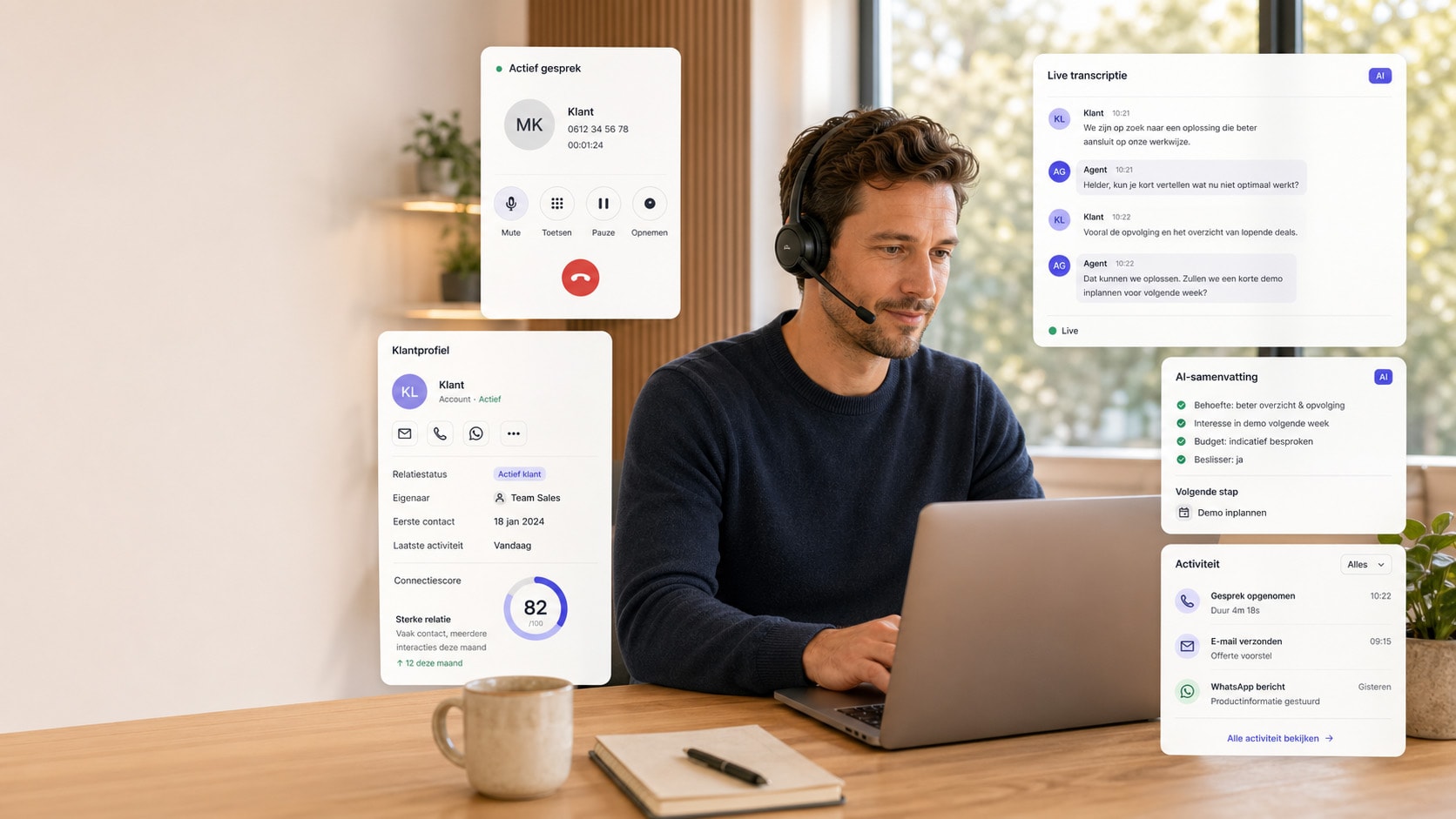
Call from your workspace. Capture context while the call happens.
Call from SideIQ instead of a separate dialer sitting beside the customer card.
Conversations are recorded and transcribed during the call, not after it is over.
Call state, transcript and summaries land on the same customer thread as mail, WhatsApp and documents.
The foundation is in place. The end-user screen is being finished in the final phases.
What you get
01
Telephony that does not stop when the call ends.
The telephony layer brings calling, recording, transcription and assist context into one model. Not as a separate phone product, but as a channel that uses the same customer context as the rest of SideIQ.
02
Browser calling
WebRTC and server-side call control from the SideIQ workspace
03
Call recording
recordings attach to the right conversation and customer dossier
04
Live transcription
text appears during the call, not in a delayed batch
05
Realtime assist boundary
call state and transcript stay separate but converge for AI assist
06
Knowledge suggestions
transcript updates can trigger relevant articles and scripts
07
Automatic summaries
post-call summaries generate when call and transcript are ready
08
Provider layer
Telnyx is the first runtime, with room for provider-neutral contracts
MODULE · TELEPHONY AND CALL RECORDING
Telefonie als onderdeel van klantcontext. Gesprekken, transcripties, realtime AI-assistentie en opvolging blijven verbonden met CRM, dossiers en SideIQ Intelligence.
Why this is different
How teams usually work
A standalone dialer records the call, someone types notes into CRM, and transcription or recording lives in yet another place. Busy teams lose the exact context the call was meant to capture.
How SideIQ structures it
Telephony events are shaped independently of the provider, projected into realtime assist context and stitched with transcript hydration. Knowledge suggestions, summaries and customer dossiers can use the same source.
What your team gains
End users will call from the same workspace where customer cards, dossiers, knowledge and next actions already live. Less retyping, less memory work and fewer gaps between call and follow-up.
Why this is necessary
Conversations are where context is created
Without connected telephony, your team must reconstruct what was said after each call. The customer asked questions, gave signals, made appointments or requested follow-up, but that information often ends up in loose notes, reminders or a recording that no one listens to anymore.
That is exactly where separate calling systems fall short. They connect the conversation technically, but do not always understand what the conversation means for CRM, files, planning, quotations, knowledge or follow-up. Once telephony lives outside SideIQ, the system loses its richest source of customer context.
SideIQ therefore makes telephony part of the Business Operating System. Conversation, transcript, recording, customer context, knowledge, real-time AI assistance, and actions stay connected within the same workflow. The more conversations run via SideIQ, the better SideIQ Intelligence understands what customers ask, where opportunities lie, what risks arise and what next step is logical. This way, your team receives support when the conversation takes place, not when it is too late.
Examples
Sales calls
call notes, recording and transcript beside the opportunity and customer card
Support calls
live context and knowledge articles next to the conversation
Customer handover
summary and next steps remain on the thread
Quality control
recording and transcript make coaching and training searchable
Quality control
recordings, transcripts and signals make training, coaching and improvement traceable